RISAnet | ||
The backbone of the NSTA is the sophisticated RISAnet(Reciprocal Integrated Satellite Array NETwork) system, which incorporates cybernetics, satellite communications, and earthbound databases to provide an extraordinary resource. Each Field Agent, Intel Officer and Commander is implanted with an uplink that is continuously active - even while the Agent is unconscious. The implant operates on RF, and is capable of receiving all frequencies in use today, but only transmits on registered ones.
Attached to the communications implant is a cuff that surrounds the optic nerve, providing the internal HUD(Heads-up Display) and encoding any visual information the Agent wishes to send. The Agents control the connection through the internal HUD, which relies on a complex set of eye movements and blinks to execute commands. Using this system, all of the NID(National Identification Database) information is available in (literally) an eyeblink, as are GPS coordinates and most of the internet. The most groundbreaking aspect of the RISAnet system is the reciprocal nature of the link; large amounts of data or very process-intensive functions can be spread across a team of agents to speed transmission. In this way, the operative's brain itself can be used to store data for a short period of time, or process a particularly difficult function, even while asleep. This is completely automatic, and never noticed by the agent (although some complain of strange dreams). | ||
| ||
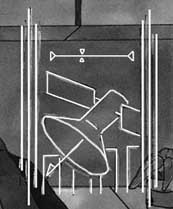
A RISAnet Satellite |

To enable this lightning-fast communication, 8 dedicated communications satellites (RISA 1-8) and 24 auxillary positioning/routing satellites (RISA 9 -32) orbit the earth. RISA 1 - 8 are in geostationary orbit, and specific teams are assigned to each one. If there is too much traffic on one particular satellite, the overflow will be automatically shunted to the next closest one available via RISA 9 - 32. This keeps the network running as efficiently as possible. Even so, lag does occur, and agents are requested to keep unnecessary traffic to a minimum.
Along with the cybernetics, each operative is assigned a unique RISAnet ID, similar to a call sign for military pilots. Agents generally refer to each other by these IDs, as opposed to "real" names -- and are, in fact, discouraged from learning their teammates' given names (this cuts down on the temptation to look up coworkers' records in the NID, or similar abuse). All RISnet IDs must be approved by the Commander and the IS Department, and are kept throughout the Agent's employ. If an operative leaves the NSTA, the ID is retired and cannot be used again for at least five years. Since the RISAnet ID is also the Agent's KALI system Username, keeping mistaken identities to a minimum is crucial.